![[Home]](upload/neurojson_banner_plain.png)
🧠 fNIRS Open Dataset Contest 2026
Vote NOW!, closing on Oct 17, 2026, 11:59 PM (Beijing Time)
Contest Overview
Community votes: 70% — Open voting for all SfNIRS members and broader community
Timeline
- 1st Prize
- USD $2,000 or flight + conference fee + hotel in Macau (up to $2,000 total)
- 2nd Prize
- USD $1,000 or conference fee + hotel (up to $1,000 total)
- 3rd Prize
- USD $500 or conference fee waiver
Sponsors
- 🥇 GOLD
- 🥈 SILVER

- 🥉 BRONZE

Rating Criteria
Dataset Eligibility
- Datasets that have not been previously published — including new datasets and datasets associated with prior publications where the data was not publicly released
- New datasets are encouraged to submit as a Data Paper for the "fNIRS Commons: Datasets and Tools for Open, Reproducible Science" Special Issue of Neurophotonics (no publication fees for Data Paper)
- Can include measurements from humans, animals, or synthetic datasets (e.g., simulated fNIRS signals for developing signal processing methods)
- Can be submitted from any fNIRS research lab
- Must follow ethical and legal requirements, such as de-identification of human data
- Submissions can include any type of fNIRS data: task-based, resting-state, or naturalistic recordings
- Dataset must be submitted to one or multiple public data hosting websites (OpenNeuro.org, NeuroJSON.io, DANDI Archive, etc.) and provide public URLs in the submission form
Dataset Hosting and Conversion Resources
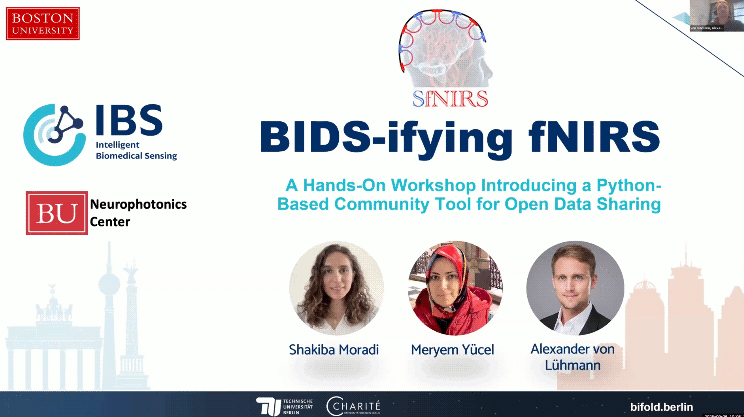
BIDS-ifyfing fNIRS Hands-On Workshop:
NeuroJSON.io
For this data contest, the NIH-funded NeuroJSON project offers free data hosting services at our data portal, NeuroJSON.io, for all participating datasets. In addition, NeuroJSON developers will also commit resources to help participants convert their datasets to the standardized BIDS format (or NeuroJSON format if the dataset does not fit within the scope of BIDS). Please reach out to the project maintainer, Dr. Qianqian Fang (q.fang@neu.edu), to request help with data conversion.
NeuroJSON.io is an NIH-funded neuroimaging dataset dissemination portal with a focus on accelerating fNIRS dataset sharing. By utilizing the universally supported JSON format and high-performance NoSQL databases, the NeuroJSON platform can host large amounts of complex datasets with high scalability, easy searchability, and programmable access in most programming environments via RESTful APIs.